
Thursday, May 31, 2012
Samos and Ephesus
Today was a busy day of ruins, visiting Samos in the morning and Ephesus in the afternoon. At Samos, the chief attraction was the Vathy Museum, with its monumental kouros and the original statues from the Genelaus family complex, and, on site, the Heraion. Ephesus offered a greater number of sights, including the newly uncovered Terrace Houses and the Library of Celsus. For more on the Terrace Houses, see below.
I was glad to see the last of Myrto, who persisted in providing inaccurate information (Samos was pillaged by Verres--she was confusing it with Sicily) and retelling the same myths over and over. The carelessness of the tour guides is by far the worst feature of the cruise. I keep reminding myself that they are pitching it to the lowest common denominator; but, judging by the number of academics I've encountered so far, they have badly underestimated the intelligence of the clientele. (I keep remembering the tour of Ireland after the international feminist conference in 1987, where the entire bus stopped the tour guide in the middle of her spiel about leprechauns and demanded to know about history and politics instead.)
 The guide who took us to Ephesus was a Turkish male who fancied himself a comedian and flirted with the ladies, when he wasn't being condescending. His worst faux pas was making potty jokes as we toured the latrine. On the other hand, the visit to the Terrace Houses was really informative because of the extent to which the interior decoration was preserved (in some cases, better than that at Pompeii). Wall painting ranged in date from the second to fourth centuries CE. Terrace House 6, obviously that of an extremely wealthy family, had a great hall covered in marble, like that of the Domus Augustana, while Terrace House 2, which was subdivided and let to poorer renters during the fourth century, had inscribed graffiti listing prices--at some time, a taberna must have been located there. Rooms were still nicely decorated, with impressive mosaics including one of a lion and another of Neptune and Amphitrite. Painting style, although reminiscent of Pompeiian fourth style, had unusual iconography--painting on doorway passage and small allegorical female figures on white background are features I have seldom encountered before.
Although we should have known better, we later went to a showing of Turkish rugs arranged by our guide. The head salesman targeted Ron while I was trying to take a photograph of the display and proceeded to try a hard sell on both of us. We got away without buying anything, but only by being rude and walking out. Although I would like to do some shopping in Istanbul, the hassle would probably be overwhelming, especially if I were to try buying jewelry.
The guide who took us to Ephesus was a Turkish male who fancied himself a comedian and flirted with the ladies, when he wasn't being condescending. His worst faux pas was making potty jokes as we toured the latrine. On the other hand, the visit to the Terrace Houses was really informative because of the extent to which the interior decoration was preserved (in some cases, better than that at Pompeii). Wall painting ranged in date from the second to fourth centuries CE. Terrace House 6, obviously that of an extremely wealthy family, had a great hall covered in marble, like that of the Domus Augustana, while Terrace House 2, which was subdivided and let to poorer renters during the fourth century, had inscribed graffiti listing prices--at some time, a taberna must have been located there. Rooms were still nicely decorated, with impressive mosaics including one of a lion and another of Neptune and Amphitrite. Painting style, although reminiscent of Pompeiian fourth style, had unusual iconography--painting on doorway passage and small allegorical female figures on white background are features I have seldom encountered before.
Although we should have known better, we later went to a showing of Turkish rugs arranged by our guide. The head salesman targeted Ron while I was trying to take a photograph of the display and proceeded to try a hard sell on both of us. We got away without buying anything, but only by being rude and walking out. Although I would like to do some shopping in Istanbul, the hassle would probably be overwhelming, especially if I were to try buying jewelry.

Delos
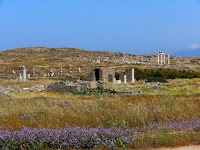
While the ruins themselves are not as spectacular as those we are supposed to see at Ephesus and Aphrodisias, Delos is undoubtedly a place that a classical scholar has to visit at least once in her life. To perceive the barrenness of the island is to realize the paradoxical quality of its importance as celebrated in the Homeric Hymn to Apollo and Callimachus' Hymn to Delos. Here is a panoramic glimpse of the site.
 After returning to the ship and listening to a presentation on Ephesus--quite tepid, in contrast to the vivid and lively talks by Bill and Suzanne--I was hoping to see the windmills of Mykonos and perhaps do a little shopping. The winds, however, were fierce, making it impossible for Ron to get into the tender. We settled instead for coffee on the observation deck and our respective books. Not a particularly eventful afternoon and evening, but one can't be entertained all the time.

Rhodes
This morning's excursion to Rhodes has been one of the better experiences of the cruise (and a considerable improvement over the Knossos fiasco). Our guide Maria (tour guides vary with the locale) took us on a bus trip around the Graeco-Roman acropolis (photo-ops but no chance to get out and walk the site), then led us on a brisk walk from the reconstructed Grand Master's Headquarters in the Fortress of the Knights of St. John down the Street of the Knights to the Hospital, now the Archaeological Museum of Rhodes. The headquarters, destroyed by an explosion under the Ottoman Turks and rebuilt by the occupying Italians as a residence for the then king Victor Emmanuel III under Mussolini, features colorful late antique mosaics in an excellent state of preservation from houses and basilicas on Cos. The museum, though, was the real gem. It contains some splendid ancient sculpture, and I was excited to see the very different iconography of late antique local funerary steles, which represent individuals and families in full-body frontal position.
 Of course, the great treasure there is the stele of Krito and Timarista, certainly without any Athenian parallel, as far as I know. If I ever teach Women and Gender in Antiquity again, it would be nice to use the image below as the basis of a paper question.
The afternoon and evening were also a treat. We found that coffee and tea were available all day on the observation deck, a comfortable place to sit and read. In the evening we heard Bill give a superb lecture on the siege of Rhodes by Demetrios son of Antigonos the One-Eyed in 305 BCE. Our ship was moored in the harbor where the battle actually took place, lending the lecture an immediacy that AIA lectures don't normally have. Afterward, the whole AIA tour group had dinner together in the Terrace Cafe. The food was excellent, wine flowed freely, and even the least communicative found shared interests. This was without doubt the best day of the entire cruise so far. If they were all like that, I would be going on one every year.
Of course, the great treasure there is the stele of Krito and Timarista, certainly without any Athenian parallel, as far as I know. If I ever teach Women and Gender in Antiquity again, it would be nice to use the image below as the basis of a paper question.
The afternoon and evening were also a treat. We found that coffee and tea were available all day on the observation deck, a comfortable place to sit and read. In the evening we heard Bill give a superb lecture on the siege of Rhodes by Demetrios son of Antigonos the One-Eyed in 305 BCE. Our ship was moored in the harbor where the battle actually took place, lending the lecture an immediacy that AIA lectures don't normally have. Afterward, the whole AIA tour group had dinner together in the Terrace Cafe. The food was excellent, wine flowed freely, and even the least communicative found shared interests. This was without doubt the best day of the entire cruise so far. If they were all like that, I would be going on one every year.

Monday, May 28, 2012
Crete
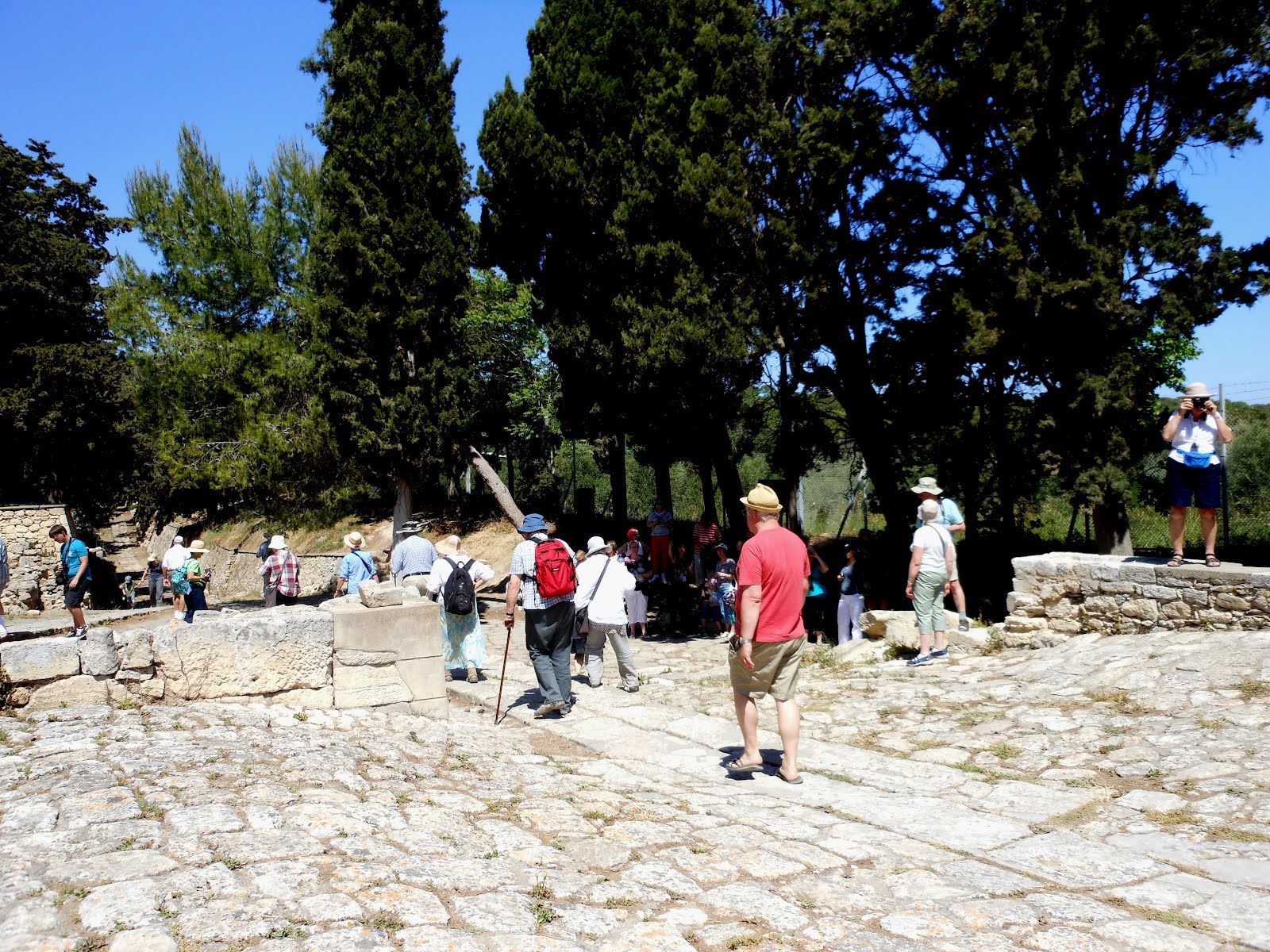
I was looking forward to seeing Knossos. On my first visit to Greece in 1967, I never left the mainland and only later realized that I should have taken the opportunity to explore more Bronze Age sites. So one factor in choosing this particular cruise was the prospect of a full day there. However, the itinerary put us at Crete on Monday, a day when Greek museums are closed. Thus we had no chance to see the original Knossos frescoes at the Heraklion Museum. The site itself was a sad disappointment. Like Pompeii, Knossos attracts hordes, tour groups were everywhere running into one another, and we could see just the exterior of Evans' reconstruction. The Throne Room and the Queen's Chamber could only be viewed through (dirty) plexiglass.
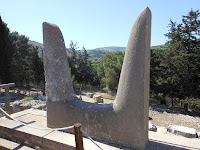 Marc Raynor said that when he brought his kids there several decades ago, nothing on the site was restricted and there were merely a handful of visitors. The fact that Evans' concrete walls are crumbling--again, like houses in Pompeii--comments ironically upon the great archaeologist's aspirations. Well, at least the sacral horns (left) are holding up soundly.
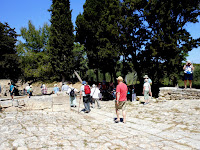 I was also pleased to learn the exact location of the so-called Dancing Floor of Ariadne at the end of the processional way (right). It makes the reference in Book 18 of Homer's Iliad all that more mysterious.

Monemvasia

Mycenae and Epidaurus
So far I have not been impressed by any of the Greek guides. They're friendly enough, but they've all been through the same training program. Hearing the identical anecdote retold twice in one day by two different persons (with slightly different details) becomes tedious. Occasionally the information provided is downright wrong, and the guide must know that. For example, at the Epidaurus Museum the guide told the group that the inscriptions on the wall were records of cures at the temple of Asclepius. They weren't; they were clearly labeled in Greek and English as records of construction expenses. On the positive side, though, Mycenae is much more accessible than it was the first time I visited there in 1967, but it hasn't lost any of its numinosity. Here is the dromos of the Treasury of Atreus.
 Epidaurus, which was much less crowded, was certainly pleasant, even in the afternoon heat. The parodos of the theatre has been reconstructed, but the rest of the structure is much the same as it was in antiquity.

Cape Sounion and Embarcation
For our last land excursion before embarking on the Aegean Odyssey, we traveled out to Cape Sounion to see the Temple of Poseidon. Basically, a relaxing drive through beautiful country and an impressive sight. The ruins are quite imposing and the surrounding vistas gorgeous.
Highlight of the trip was the noisy partridges that could be heard all around us and occasionally glimpsed. This fellow posed nicely for photos (below).
 After returning to the hotel, we boarded a bus for the Piraeus and transferred to the Aegean Odyssey.
Though this ship is relatively small as cruise ships go, it certainly has all the amenities. While our stateroom is tiny, we don't find it confining. Chris, our steward, is extremely attentive. We didn't see any of our fellow AIA voyagers the first evening, which I spent in the Charleston Lounge, having a drink and updating this journal.
I discovered, however, that in the rush of morning packing I had left Averil Cameron's book on late antiquity, borrowed from the University library, back in the hotel room. Internet on the ship is incredibly slow, but I finally managed to contact the hotel staff and ask them to mail the book back to me, charging my VISA for the postage. They were very courteous and reassuring. While spending a couple of expensive hours on the Internet, I also gave permission as one of the co-editors to send the proofs of Narrating Desire to press. Getting that manuscript into production was a miserable process, involving much wasted and reduplicated effort. Even if there are still a few typos, I'll be happy to hear no more of it. When I return to Tucson, the first priority, finally, will be finishing off Sexuality!
After returning to the hotel, we boarded a bus for the Piraeus and transferred to the Aegean Odyssey.
Though this ship is relatively small as cruise ships go, it certainly has all the amenities. While our stateroom is tiny, we don't find it confining. Chris, our steward, is extremely attentive. We didn't see any of our fellow AIA voyagers the first evening, which I spent in the Charleston Lounge, having a drink and updating this journal.
I discovered, however, that in the rush of morning packing I had left Averil Cameron's book on late antiquity, borrowed from the University library, back in the hotel room. Internet on the ship is incredibly slow, but I finally managed to contact the hotel staff and ask them to mail the book back to me, charging my VISA for the postage. They were very courteous and reassuring. While spending a couple of expensive hours on the Internet, I also gave permission as one of the co-editors to send the proofs of Narrating Desire to press. Getting that manuscript into production was a miserable process, involving much wasted and reduplicated effort. Even if there are still a few typos, I'll be happy to hear no more of it. When I return to Tucson, the first priority, finally, will be finishing off Sexuality!

Subscribe to:
Posts (Atom)